Michigan Spray Foam Insulation

New Construction Spray Foam Insulation in Michigan

Certified Michigan contractors. Serving Detroit, Grand Rapids, and communities statewide. Same-week estimates, no obligation.

(517) 234-2744 Fully Insured Same-Week Estimates Statewide Coverage

As a Michigan-based spray foam insulation contractor, we specialize in new construction projects — from framing-stage rough-ins to final air-sealing passes. When you’re building or renovating a home in our service area, you need insulation that meets code, fits your budget, and works with the schedule of other trades. We show up on time, understand builder workflows, and deliver spray foam that meets the demands of our climate.

Michigan’s residential energy code requires R-49 attic insulation for most of the state, per the International Energy Conservation Code (IECC) Zone 5A. For builders and general contractors, that means a minimum standard — but we often go beyond it to ensure long-term comfort, energy efficiency, and code compliance. Spray foam is a powerful tool in that effort, and we’ve fine-tuned our process to make it a smooth part of new construction.

Rough-In Timing and Trade Coordination

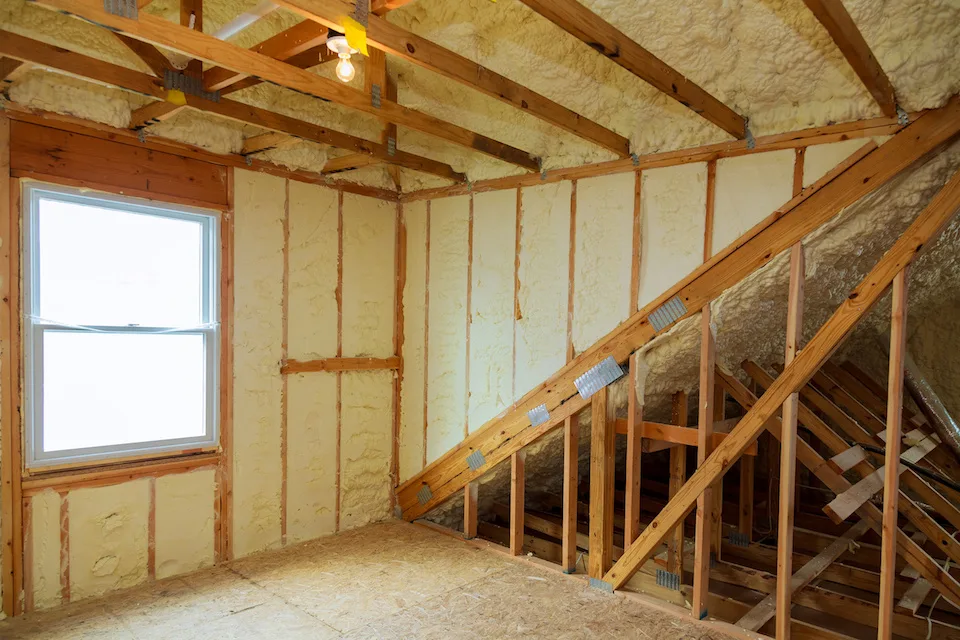
Spray foam in new construction is a precise process that needs to be scheduled with other trades. We typically work during the rough-in phase, before drywall and HVAC ductwork are installed. This timing allows us to seal critical air leakage paths — such as rim joists, wall cavities, and attic hatches — before they’re covered.

We coordinate directly with general contractors and builders to sequence our work around electrical, plumbing, HVAC, and drywall crews. This ensures we don’t disrupt other trade work and that we can access cavities without later tear-outs or rework. Our team is familiar with flash-and-batt hybrid assemblies, which pair spray foam in critical areas (like rim joists and wall cavities) with batt insulation elsewhere. These systems maximize air sealing and energy performance while keeping costs in check.

Code Compliance in Climate Zone 5A

Michigan’s climate, particularly in the Lower Peninsula, is defined by IECC Climate Zone 5A, with an average of 6,200 to 6,900 heating degree days per year. That means homes need strong insulation and air sealing to stay comfortable and efficient. Spray foam is a great fit here because it not only provides high R-values but also prevents air infiltration, which is a major source of energy waste.

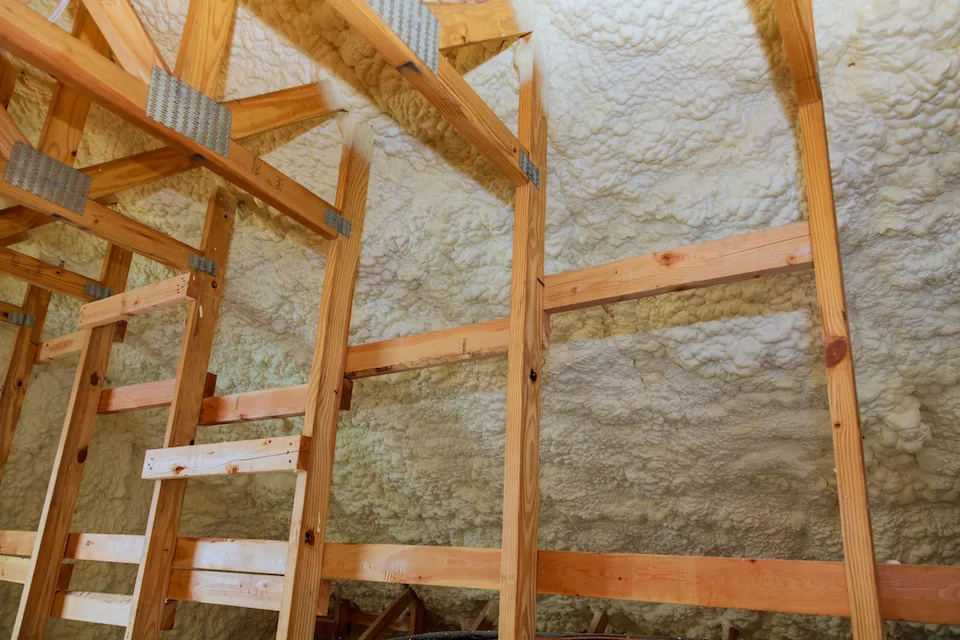
Closed-cell spray foam delivers approximately R-6 to R-7 per inch, and open-cell foam delivers R-3.5 to R-4 per inch. For new construction, we often recommend closed-cell spray foam in critical areas like rim joists and crawl spaces for moisture resistance, and open-cell foam in attics and wall cavities where airflow and flexibility are important.

We ensure all our spray foam installations meet or exceed Michigan’s residential energy code, including the R-49 attic insulation requirement. Our crews also support builders who are working toward HERS Index goals, which track a home’s energy efficiency relative to a standard reference home. A lower HERS score means a more efficient home — and spray foam is one of the most effective ways to reduce that score during new construction.

Flash-and-Batt Hybrid Assemblies

Many new homes in Michigan use flash-and-batt assemblies, which combine spray foam with batt insulation. This approach is especially popular in wall cavities and attic floors, where it allows for a high-performance, cost-effective solution.

In a flash-and-batt setup, we typically spray foam in the first 2 to 4 inches of each cavity to seal air leaks, then fill the rest with batt insulation. This method gives you the air-sealing benefits of spray foam with the cost advantages of batts. We make sure the flash foam is thick enough to prevent air movement and maintain code compliance.

This hybrid approach is ideal for builders who are looking to optimize performance and budget without sacrificing quality. It’s also compatible with blower-door testing and HERS certification, which are becoming standard in new home construction.

Blower-Door and HERS Advantages

Spray foam is a key component in high-performance, energy-efficient homes, and it plays a big role in blower-door testing and HERS certification. Blower-door testing measures how airtight a home is, and spray foam significantly reduces infiltration and exfiltration compared to traditional fiberglass.

We work closely with HERS raters to make sure our spray foam installations support the goals of their energy modeling. A well-sealed home with spray foam often sees a 20–40% reduction in heating and cooling costs after installation — and that’s a win for both the builder and the future homeowner.

What It Costs

Spray foam pricing in new construction depends on several factors, including the type of foam used, the amount of access needed, and whether existing insulation must be removed. Here are the typical cost ranges we see in our service area:

Final pricing will depend on access, required thickness, and any removal of existing insulation. We always price based on actual conditions and give you a written quote before work begins.

You can learn more about spray foam cost in Michigan and how it fits into your new home’s budget.

Lake-Effect Moisture and Housing Stock

Many new construction projects in our area involve rehabbing or expanding older homes — especially 1950s–1970s ranches and colonials, which often feature balloon framing and limited insulation. These homes are particularly vulnerable to air leakage and moisture issues, especially in the northern parts of the state where lake-effect snow and humidity are common.

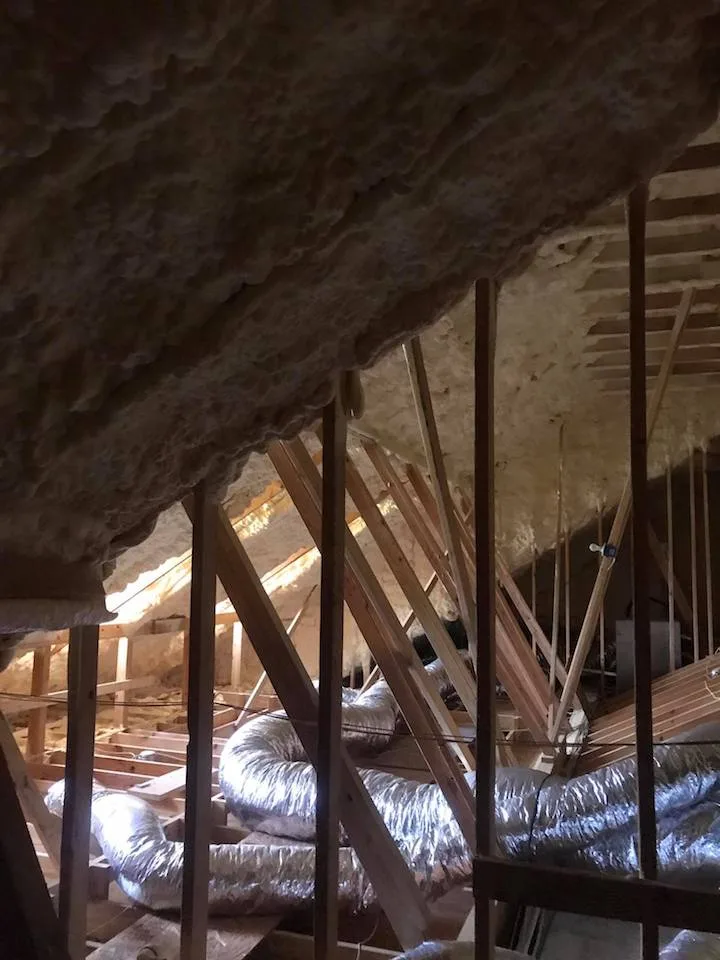
Spray foam is a powerful solution for these types of homes because it air-seals the entire envelope, preventing the kind of interstitial condensation that can occur in older wall cavities. We often pair our attic and rim-joist work with crawl space encapsulation to fully address moisture risks and improve indoor air quality.

Get a Written Quote

We’re a Michigan contractor who shows up on time, works with your schedule, and delivers clean, code-compliant spray foam installations. If you’re planning a new construction project and want to include spray foam in your plans, we’ll come out for a free on-site estimate and give you a written quote before we ever start work. No hidden fees, no surprises — just straight, honest pricing that fits your project and your budget.

Related services and service areas

We install spray foam across Lower Michigan. Explore related work: attic insulation, crawl space encapsulation, rim joist insulation, pole barn insulation, and commercial spray foam. See what spray foam costs in Michigan, or jump straight to your city: Detroit, Grand Rapids, Lansing, Ann Arbor, Kalamazoo, Muskegon, and Midland.

2021 Code and Blower-Door Details

  • The source says Michigan adopted IECC 2021 in 2022 and identifies four common residential requirements: R-49 attic insulation, basement walls at R-20 continuous or R-13 cavity plus R-5 continuous, R-10 underslab for at least two feet from the perimeter, and 3 ACH50 maximum for new construction.
  • Typical 1960s and 1970s ranches in Ferndale, Royal Oak, and Ingham County are described as testing around 8-15 ACH50, three to five times the new-construction limit.
  • Fiberglass can reach R-value but cannot serve as the continuous air barrier required by code; source examples of failure points include top plates, rim joists, attic hatch framing, mechanical penetrations, recessed cans, bath fans, and dryer vents.
  • Three inches of two-pound closed-cell foam is cited at about R-21 with Class II vapor-retarder performance and air sealing in one application.
  • For new builds in Oakland, Livingston, or Kent County, the source says the blower-door result can determine occupancy because failing 3 ACH50 triggers corrections and a second test.

West Michigan Builder Spec Addendum

  • The source identifies Zone 5A code requirements across Grand Rapids, Holland, Zeeland, Kalamazoo, and Ottawa County: R-49 attics, R-49 cathedral ceilings or equivalent, R-20 or R-13+R-5 above-grade walls, R-15 continuous or R-19 cavity basement walls, and R-15 continuous crawl-space walls.
  • West Michigan examples include Eastbrook communities such as Thornwood in Caledonia, Whispering Ridge in Jenison, and Byron Center corridor developments, where rim joist foam may be standard and attic spray foam may be an upgrade.
  • Allen Edwin is described as using open-cell attic spray foam in some energy-efficient packages across West Michigan, Battle Creek, and Kalamazoo markets.
  • Holland and Zeeland lakefront/custom builds are tied to higher wind exposure, with some custom buyers targeting 1.5 ACH50 or lower, below the 3.0 ACH50 code ceiling.
  • Consumers Energy new-construction incentives are described as including high-efficiency air-sealing bonuses for homes at 2.0 ACH50 or below, whole-home energy packages, and production-builder program tracks.
  • The proposed buyer spec addendum includes two inches of closed-cell at all rim/band joist sections and penetrations, explicit vented vs unvented attic assembly, wall assembly type and expected R-value, blower-door test result, and progress photos before drywall.

Cities We Serve

Detroit Grand Rapids Ann Arbor Lansing Kalamazoo Flint Sterling Heights Troy Livonia Dearborn Royal Oak Muskegon Holland Midland

Frequently asked questions

How much does spray foam insulation cost in Michigan?

Spray foam insulation in Michigan typically costs $1.00–$1.60 per board foot for open-cell foam and $1.60–$2.60 per board foot for closed-cell foam. A typical attic runs $1,800–$4,500 for a typical 1,200 sq ft attic; rim joist projects average $1,200–$2,500. Final pricing depends on access, required thickness, and any removal of existing insulation.

What is the difference between open-cell and closed-cell spray foam for Michigan homes?

Closed-cell spray foam delivers approximately R-6 to R-7 per inch; open-cell approximately R-3.5 to R-4 per inch. Closed-cell is recommended for Michigan basements, crawl spaces, and rim joists because it provides a Class II vapor retarder — critical in cold, humid winters. Open-cell is preferred for many attic applications and costs less per board foot. Our service area sits in IECC Climate Zone 5A; northern Lower Michigan and the Upper Peninsula are Zones 6A and 7. Code requires R-49 minimum attic insulation under Michigan's residential energy code (IECC Zone 5A).

How long does spray foam insulation last in a Michigan home?

Spray foam is a permanent insulation with an expected lifespan of 80+ years without sagging or compressing when properly installed. Unlike fiberglass batts, it does not compress, sag, or absorb moisture. In Michigan's freeze-thaw climate, closed-cell foam also adds rigidity to walls and rim joists and prevents the moisture infiltration that shortens the life of other insulation types.

How much can spray foam insulation reduce energy bills in Michigan?

Homeowners typically see 20–40% lower heating and cooling costs after air sealing and insulation, depending on the home's starting condition. Most of Lower Michigan logs roughly 6,200 to 6,900 heating degree days per year. Spray foam's dual function as insulation and air barrier eliminates the convective heat loss that fiberglass batts alone cannot address.

Are rebates or tax credits available for spray foam insulation in Michigan?

DTE Energy and Consumers Energy offer rebates for qualifying insulation and air-sealing upgrades through their Home Energy Efficiency programs. Amounts vary by measure and change annually — confirm current amounts at dte.com or consumersenergy.com before your estimate. The federal 25C Energy Efficient Home Improvement Credit ended December 31, 2025. No federal tax credit currently applies to insulation work; utility rebates remain available.

Get a Free Spray Foam Estimate

Tell us about your project and our crew will get back to you with a written quote within one business day.

Call us directly: (517) 234-2744
Request a Free Estimate

Call Now Free Estimate